Thanks to our Nature Network partner Nature Alberta for providing this month’s blog.
Up on the high rocky peaks where few large animals dare to tread, the mountain goat makes it home. One of Canada’s most unique wildlife species, this hardy mountaineer is one of the classic symbols of the rugged high country of the west.
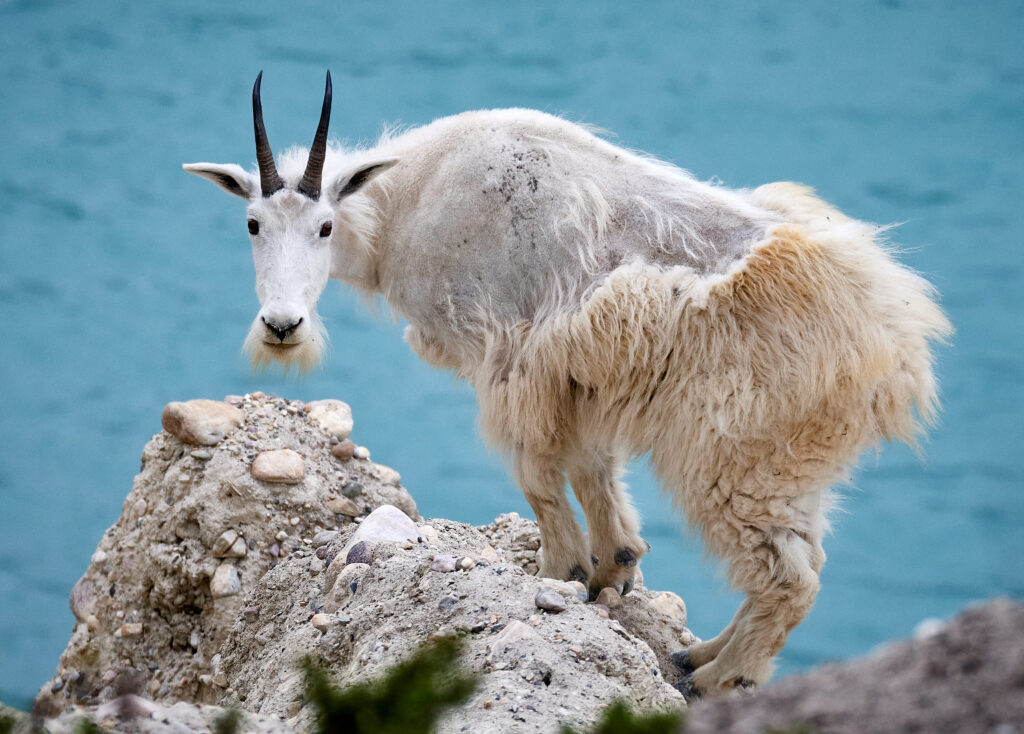
Mountain goat (Photo: Archie Richardson)
The ‘Goat’ That’s Not a Goat
Not much in the Canadian wilderness looks like a mountain goat, making them easy to identify at a quick glance. Mountain goats (called Matx by the Nisga’a Nation of western British Columbia ) are even-toed ungulates in the same Order of mammals as deer, camels, pigs, cattle, and even whales. Adults are about 1.5 metres long, around a metre tall at the shoulder, and weigh from 45-135 kilograms. They are stocky-looking animals with stout legs and shoulders. The all-white fur of mountain goats is long and shaggy in the winter to protect them from harsh mountain weather, but falls off in clumps in June, revealing the much shorter summer coat (see photo above). Both adult males and females have conical black horns that taper to sharp points; in males they’re thicker and more evenly curved. The hooves have a rough-textured pad under the hard outer layer, which helps the animals to grip the rock and climb sheer surfaces.
The long face, beardy chin, and horns give these animals a very goat-like appearance. But don’t be fooled by the look or name of this animal. While mountain goats and “true goats” like what you’ll find on a farm do belong to the same ungulate group, the Caprinae subfamily, “true goats” in the genus Capra belong to a slightly different branch on the family tree than mountain goat in the genus Oreamnos. The closest living relative to mountain goats is the takin, a large horned animal from eastern Asia. Some people refer to bighorn sheep as “mountain goats,” but bighorns are indeed true sheep.
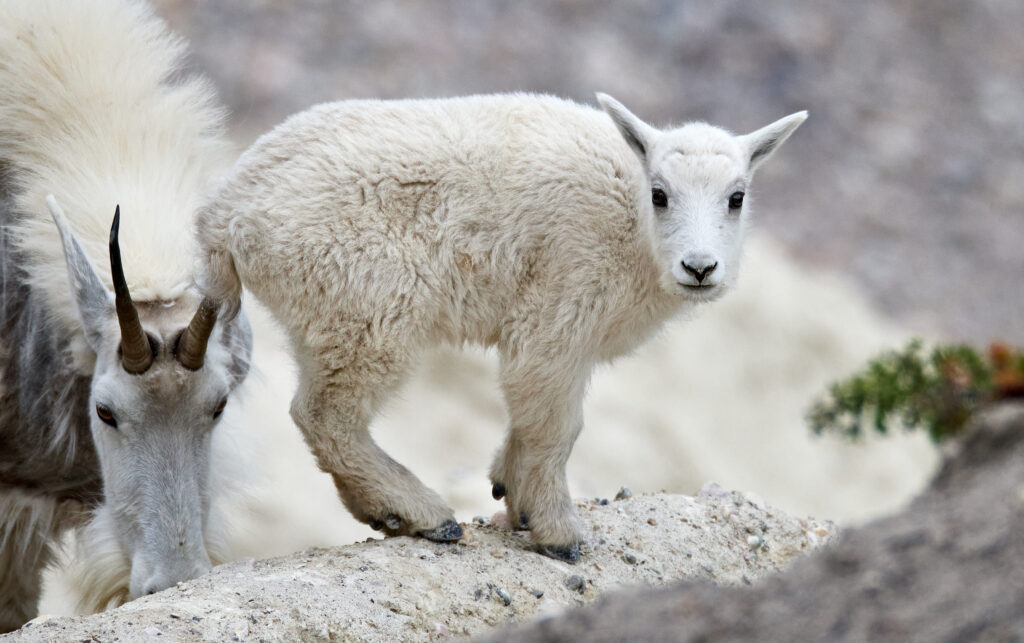
Mountain goat nanny and kid. Photo: Archie Richardson