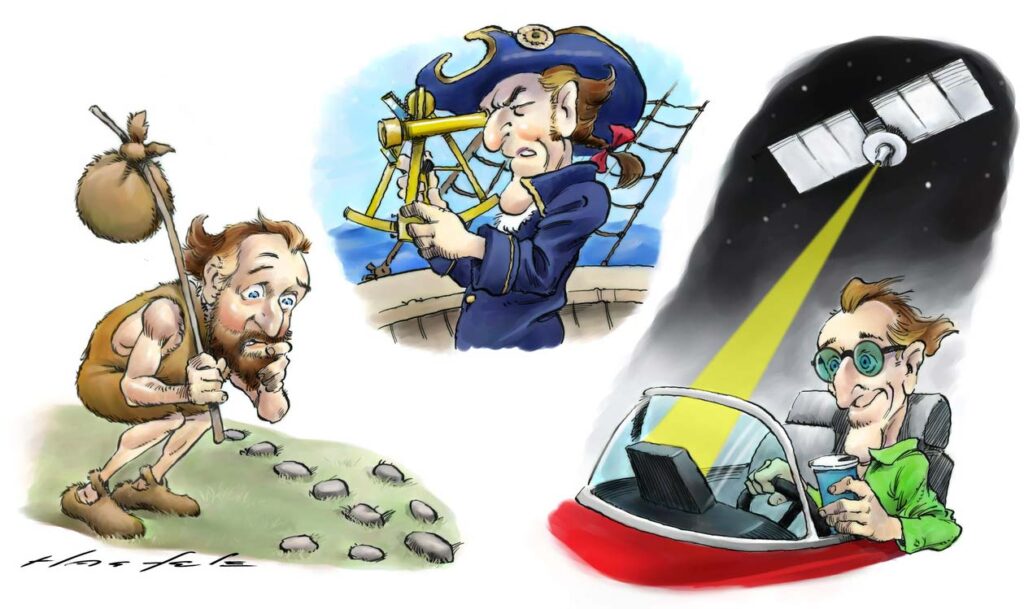
The whole history and evolution of human beings as travelers has been carried along by technology. Some might venture to say the same about human evolution itself, but certainly it’s clear that without each stage of invention, from the wheel, to the sailing ship, to the compass and sextant, the steam engine, the internal combustion engine, etc. etc. ad infinitum, we would still be walking everywhere.
It’s no great leap to say travel itself has moved forward on the tails of technology. I’m not usually an early-adopter of new products, but when the GPS appeared on store shelves I jumped right on that.
I’ve had more than enough experiences as a nightclub musician getting lost driving around trying to find some venue in New York, New Jersey or Long Island based on directions I had taken down over the phone.
Often, I failed miserably – missing a turn because a branch blocked a street sign, or discovering too late that the directions were wrong. Sometimes it went smoothly, but not often enough. When mishaps made me late to my engagement, my frustration would boil over and I would almost rip off the steering wheel in a fit of rage. Fortunately, the wheel was solidly attached.
When the early GPS systems came onto the market in the ‘90s, the power of the technology was astonishing: a device that could communicate with a satellite to tell you exactly where you were on the planet, and could guide you turn by turn to your destination. Even the earliest ones – the little separate units – removed one of the biggest barriers to travel: simply finding your way.
From Navigation to Intelligence
Over time, navigation technology evolved quickly. With MapQuest you could get directions from satellite maps and print them out. The GPS guided you in real time and adjusted when you made a wrong turn. GPS and all the real-time mapping functions got absorbed into smartphones. Then those could be run through a screen on your dashboard, turning it into a digital command center that taps into the ever-expanding powers being built around GPS technology. Now through your phone you can use it while walking through a forest. What began as a standalone tool is now seamlessly integrated into the broader travel experience.
All kinds of AI tools are being integrated into these systems and they continue to evolve, one wonder after another. It’s hard to predict what is coming, but it does seem that we are moving beyond systems that were essentially reactive, that is, you told them where you wanted to go, and they showed you how to get there. Now it appears that artificial intelligence is pushing travel technology into a phase that not only responds to instructions but anticipates your needs.
Today’s travel tools can suggest routes based on traffic patterns, recommend destinations based on past behavior, and adjust plans dynamically when conditions change. Instead of simply guiding you, they begin to act more like collaborators. Now we have crowd-sourced alerts that warn you of traffic tie-ups and problems ahead. We’ll have to keep enlarging our sense of what is possible as new capabilities keep emerging.
A Shift in How We Travel
This shift is changing the nature of travel itself. Travel has historically required a significant amount of effort: planning routes, researching destinations, making bookings, and solving problems along the way. Each step introduced obstacles and friction, and each friction point limited how far or how often people traveled.
Technology has steadily removed a lot of those barriers. Technology provided navigation tools, streamlined booking and logistics. Now, with AI, it is beginning to personalize and even predict the travel experience.
We are moving from a model in which travelers actively manage every detail to one where much of the process happens in the background. That doesn’t mean the traveler disappears from the equation. It means the mental load is reduced, freeing more attention for the experience itself.
The Road Ahead
As AI tools become incorporated into previously existing technologies, they are all part of this new wave powered by AI, and setting off a wave of change through everything. I’m often not sure where to draw the line as to what is AI and what is not. But recently I played with an app that maps the heavenly bodies in the sky where you are pointing the phone. It puts that astronomical knowledge on your phone. It’s like having an astronomer companion when you are walking under the night sky.
Another app that expands my connection with the natural environment recognizes bird calls, and can name all the bird species that are audible around you. The birds are so good at staying out of sight, I barely know they are there. I just hear their calls as part of the fabric of ambient sound. But this app introduces me to them, shows me that they are there. It opens up a new field of awareness for me.
Those are just a couple of tiny examples of an endless daily outpouring of new apps that put new powers into your hands, and new understandings into your mind. I find these expansions that are given to you by these new media and apps to be really exciting. We are just at the beginning of a tremendous wave of innovation along these lines.
Where earlier tools helped us navigate the world, some new ones can help us identify and interpret what we see. They can provide all the necessary information to get around comfortably in a foreign destination and to get the things you need, including lodging, transportation, guidance, etc., and things you want. And now, with AI, it can show you things you didn’t know you didn’t know.
For the travel industry, this opens new possibilities. Experiences can become more personally tailored. Travelers can be more independent, more knowledgeable, more secure. Barriers to exploration continue to fall away.
And yet, the core goal remains unchanged. Travel has always been about discovery – of places, of cultures, and of perspectives. Technology, at its best, makes that discovery easier and richer. This AI revolution, like most revolutions, is shaking the ground, bringing on a huge wave of change. We hear many warnings about problems that will be caused by AI, but for now, the benefits these technologies bring to the traveler are clear and present.
I often think of how Edison wired New York for electricity to provide lights. Then inventors got to work on ways to use electricity, and we got all the amazing things we have now that run with electricity. Now with this wave of technological innovation, these new AI capacities have been unleashed upon the world. I know many people, including myself, who are feeling their horizons expanding through various new technologies. We barely have an inkling right now of the new worlds this opens. The world will no doubt change. It is changing day by day, for better or worse. On the good side, these new apps are enormously empowering, and lots of fun.
For now, at least, I’m enjoying the ride.
Your humble reporter,
A. Colin Treadwell
The post GPS, AI and I appeared first on The Taucker Travel Blog.