If you get bad news about one of your trees, kindly don’t blame the messenger. Even if – especially if – they vandalize that very tree. It could save a lot of trouble, and possibly your life, to heed their message.
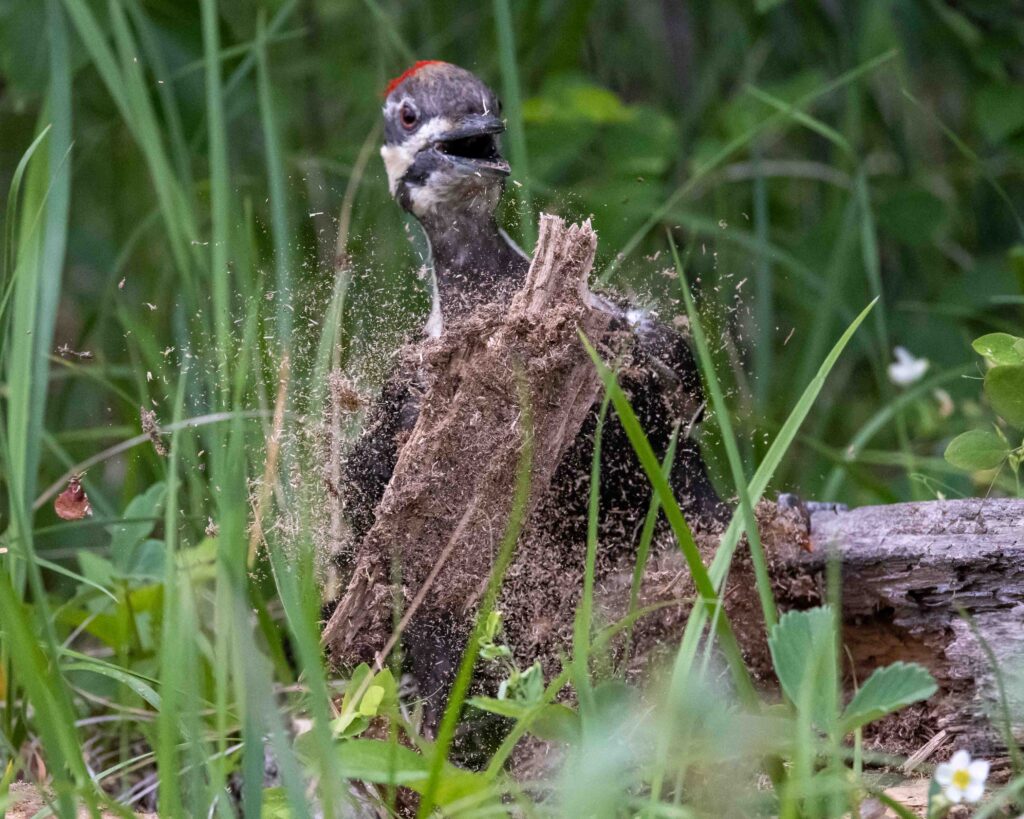
Although it’s captivating to watch a big prehistoric-looking woodpecker chisel away at a rotten snag in the forest, the same performance loses its charm when it jack-hammers a hole in your “perfectly good” tree. The thing is, no matter how healthy that tree may appear, it is definitely not sound, and may in fact be dangerous. Your “vandal” is alerting you to this truth by installing windows in the tree trunk.
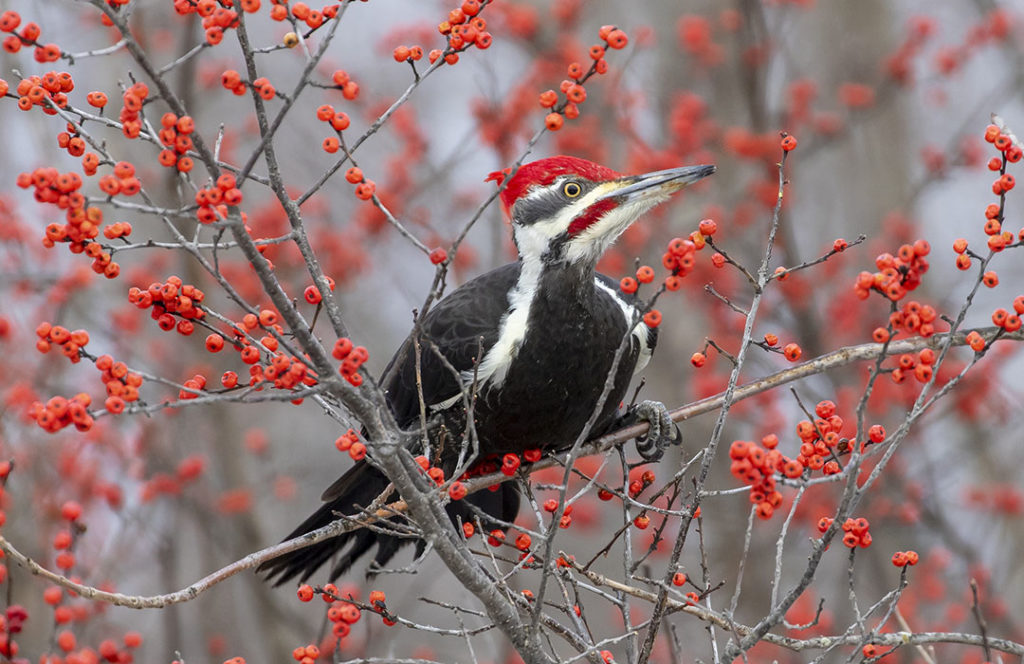
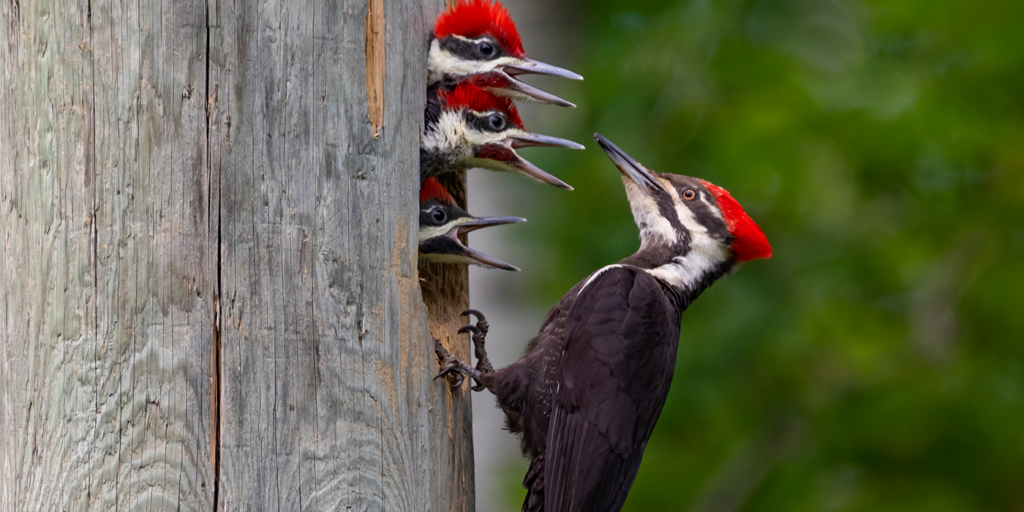
Native to the eastern United States, southeastern Canada, and a belt of Canadian boreal forest stretching to the Pacific coast, the pileated woodpecker (Dryocopus pileatus) is easy to recognize. Its prominent red crest is an attention-getter, but its size sets it apart as well. Assuming the ivory-billed woodpecker is extinct, our pileated is the largest in North America, at 40-49 cm long, with a 66-75 cm wingspan. Its body is mostly black, with a strip of white down the throat. Males and females are both red-crested, but the male has an additional red stripe on the sides of its head. Patches of white are also visible as it flies in its distinctive undulating pattern.
Pileated woodpeckers excavate large cavities in dead trees in which to nest – so large that the tree sometimes collapses at the nest site. They also “mine” dead trees for larvae and pupae of wood-boring beetles. But these birds have a special appetite for carpenter ants living in the decayed heartwood of live trees, which is what sometimes irks people when it seems that they’re attacking a healthy tree in our woodlot, sugar bush, or backyard. As unsettling as it is to see wood chips raining down from your tree, that is the least of the tree’s problems.
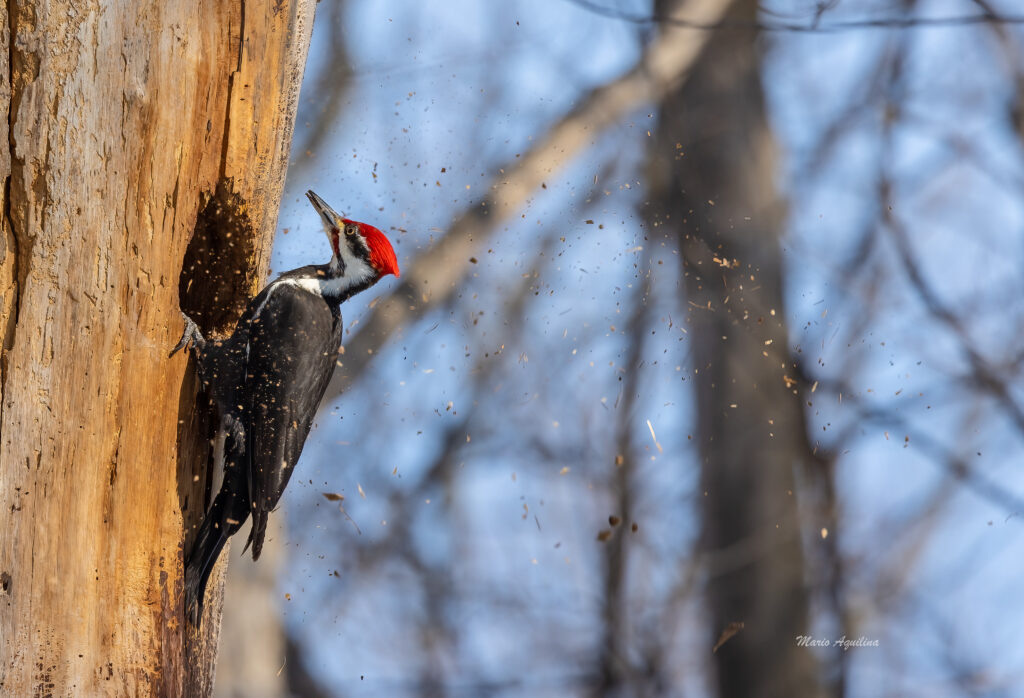
It’s tough work for woodpeckers to chop holes in wood using only their lips, so there’s always a compelling reason, such as a tasty carpenter-ant core ensconced within that hard wooden shell. It’s sort of the bird equivalent of a lollipop with a chewy centre. Once we realize these professional hackers only break into a live tree if its trunk is packed with ants, it’s logical to think we should kill those critters. The trouble is, that won’t help – ants aren’t the issue either.
In spite of their name, carpenter ants are unable to saw, router, drill, or otherwise excavate solid wood. Turns out these guys only have the chops for damp, rotted wood. They’re so named (I’m pretty sure) because when they appear at home it means you need a carpenter, as opposed to an exterminator, to replace that crumbling sill plate, joist, or other hidden piece of soggy lumber. In houses, rot may be due to faulty window flashing or leaking roofs. Heartwood rot in trees, however, begins with an injury.
Ice storms, lightning strikes, porcupines and other natural injuries are unavoidable, but we cause loads of unnecessary harm as well. Root damage is a frequent but lesser-known conduit for decay to enter, which is why it’s essential that land managers keep heavy equipment out of the woods in wet conditions. Flush-cut pruning is another type of careless and avoidable injury that can lead to internal decay.
As many arborists and foresters have written over the years, trees wall-off (compartmentalize) wounds, making barriers to exclude decay organisms. A fascinating and superbly illustrated US Forest Service bulletin by Dr. Alex Shigo, a pioneer in the understanding of how trees respond to wounds, can be found at: https://www.nrs.fs.fed.us/pubs/misc/ne_aib405.pdf
Whether or not a tree successfully compartmentalizes decay after an injury depends on its species and vitality, as well as the wound size. Bur oak, sugar maple, and honeylocust are among the species which compartmentalize robustly, while poplar, birch, and willow appear to have skipped the class on how it’s done. Obviously, poor soil, drought, defoliation and root damage curb a tree’s ability to self-protect. But even the defenses of a top-notch (so to speak) tree can be overwhelmed by a large wound.
When a tree’s defensive walls are breached, heart rot often ensues. It’s a slight misnomer, as trees without heartwood (birch, beech, basswood) get it too. Also, depending on the fungal agent, sapwood can sometimes be fair game. In general terms, heart rot affects the non-living centre section of trees, while the outer layers of water-conductive sapwood are exempt (if a tree is subject to a further large injury, sapwood can be jeopardized as well).
Broadly speaking there are two kinds of heart rot, white and brown. Brown rot, which decays cellulose only, is sometimes called dry-rot because that’s how it looks by the time we see it, long after it’s done its dirty work. While it’s active, though, it has ample moisture. It’s associated more with conifers, and you may recognize its blocky, brown, crumbly signature inside a windthrown tree. Eighty percent of wood-rot fungi are in the white-rot club, a thorough bunch able to eat lignin, the resilient “rebar” of wood, as well as carbohydrates. White rots are more common on hardwoods.
Over time, the biomass of these organisms will increase to the point that they send out fruiting bodies, spore-bearing conks that we’ve undoubtedly seen in the woods. Fomitopsis pinicola is a brown-rot fungus which produces a shiny red-belted conk, while phellinus tremulae, a white-rot, results in the hoof-shaped conk sometimes found on poplars.
Pileated woodpeckers aren’t after your tree; they’re pursuing ant colonies. In turn, ants don’t ruin your tree, but signal the presence of advanced decay within. Using insecticide on the ants will put all sorts of wildlife at risk, and is unlikely to eradicate the colony. Most importantly, it will do nothing to slow the inexorable march of internal decay.
Years ago I helped extricate a massive white pine from the attic of a house. It had snapped at about 10 metres up and crushed the roof, harpooning good-size branches into the bedrooms below. It failed because of decay which had begun at an old wound and advanced. The ants present were but a symptom; if only a woodpecker had alerted the homeowner to the situation, disaster might have been averted.
If you see woodpeckers “vandalizing” your tree, be aware that decay lurks inside. You may want an arborist to evaluate it for mechanical integrity and overall health. Heartwood decay doesn’t always mean a tree is doomed, but if it’s destined to fall, best that it happens in a controlled fashion.
Regionally, around 40 bird species depend in some way on tree cavities. Primary excavators like flickers, woodpeckers, and chickadees significantly reduce forest-pest populations during winter as they feed on insect larvae, pupae, and adults. Feeding sites and abandoned nest cavities are used by tree swallows, wrens, kestrels, owls, and dozens of other resident and migratory birds.
Because snags are critical to such species, it’s highly beneficial to leave dead forest trees standing when possible. Lower trunks of residential trees can be left when safety concerns allow. Not only does this provide key habitat, you may get a chance to observe bird species you otherwise wouldn’t see.
Paul Hetzler has been an ISA-Certified Arborist since 1996, and was a longtime Cornell Cooperative Extension educator for St. Lawrence County, NY. He avoids trees and lollipops that have soft centres.
The post Woodpeckers are Messengers, Not Miscreants appeared first on Nature Canada.